
Use this hospitality beverage glossary to build confidence with the terms guests and colleagues use at the bar, on the wine list and at the coffee station. The 64 definitions below are written for restaurant teams and hospitality students.
Check the actual product label, house recipe and local service rules before advising a guest. A familiar drink name does not establish its alcohol content, ingredients or serving measure.
Take the glossary to your next briefing
The five-page download includes every definition, source links and a simple training record.
Download the glossary PDFEdit the glossary in WordBar service
- ABV
- Alcohol by volume: the percentage of a drink’s volume that is ethanol.
- Aperitif
- A drink served before a meal; it may be alcoholic or alcohol-free.
- Digestif
- An after-meal drink. The term is a service convention, not a health claim.
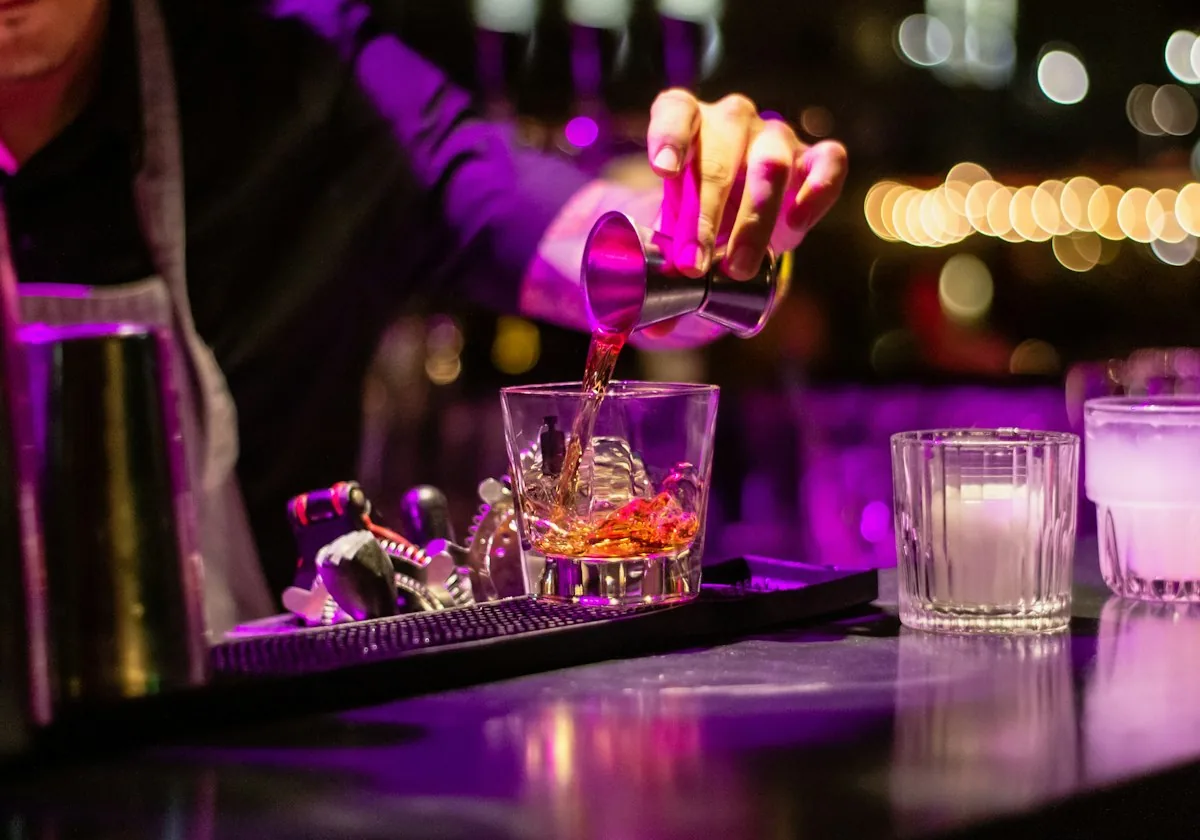
- Jigger
- A measuring tool. Check its actual marked capacity rather than assuming a universal measure.
- Neat
- Served without ice or a mixer.
- On the rocks
- Served over ice.
- Up
- Chilled during preparation and strained into a glass without ice.
- Muddling
- Pressing ingredients to release flavour; follow the recipe to avoid over-crushing.
- Shaking
- Mixing and chilling ingredients in a shaker, usually with ice.
- Stirring
- Mixing and chilling gently with a bar spoon, usually with ice.
- Straining
- Separating the mixed drink from ice or other solids.
- Boston shaker
- A two-piece shaker, commonly two tins or a tin and a mixing glass.
- Garnish
- A finishing ingredient that contributes aroma, flavour or appearance.
- Simple syrup
- Sugar dissolved in water; ratios vary and should be specified in the recipe.
- Gomme syrup
- A sugar syrup containing gum arabic; it is not simply another name for every sugar syrup.
- Bitters
- Concentrated bitter and aromatic flavouring; many versions contain alcohol.
Beer and brewing
- Beer
- A fermented beverage typically made with malted grain, water, hops and yeast.
- Ale
- Beer fermented with ale yeast. Colour and hop intensity do not define the category.
- Lager
- Beer fermented with lager yeast and commonly cold-matured. It can be pale or dark.
- Malt
- Grain that has been germinated and dried for brewing or distilling.
- Grist
- Milled grain prepared for mashing.
- Mash
- Grain mixed with water so enzymes can convert starch into fermentable sugars.
- Wort
- The sugary liquid produced during brewing before fermentation.
- Hops
- Plant cones used for bitterness and aroma in many beers.
- Yeast
- Microorganisms that convert fermentable sugars into alcohol and carbon dioxide.
- Fermentation
- The conversion of sugars by microorganisms; alcoholic fermentation produces ethanol and carbon dioxide.
- Adjunct
- A brewing ingredient such as unmalted grain or sugar used alongside the main malt source.
- Draught beer
- Beer dispensed from a tap system.
- Keg
- A container used to store and dispense beer, usually under pressure.
- Bottle conditioning
- Secondary fermentation in the bottle, often producing carbonation.
- Low or no alcohol
- Label terms whose legal definitions vary by market. Check the actual ABV and applicable label.
- Pilsner
- A lager style; not every lager is a pilsner.
Wine and spirits
- Wine
- An alcoholic beverage produced by fermenting grapes; other fruit wines are identified by their fruit.
- Dry
- In wine tasting, a style without noticeable sweetness. It does not mean high tannin.
- Acidity
- The fresh, sour aspect of a drink that can stimulate salivation.
- Tannin
- Compounds that create an astringent, drying sensation, especially in many red wines.
- Body
- The perceived weight and fullness of a drink in the mouth.
- Aroma
- The smells perceived from a beverage.
- Finish
- The sensations that remain after tasting.
- Fortified wine
- Wine to which spirit has been added during production.
- Sparkling wine
- Wine containing enough dissolved carbon dioxide to produce bubbles on opening.
- Liqueur
- A sweetened, flavoured spirit-based drink.
- Distillation
- Separating components of a liquid by vaporisation and condensation.
- Pot still
- A vessel used for batch distillation. Its use alone does not establish quality.
- Column still
- Distillation equipment using a column with multiple separation stages.
- Botanicals
- Plant materials used to flavour products such as gin.
- Brandy
- A spirit distilled from wine or fermented fruit; the fruit may be specified on the label.
- US proof
- A US strength convention equal to twice the numerical ABV; 40% ABV is 80 proof.
Tea coffee and alcohol-free service
- Camellia sinensis
- The tea plant from which black, green, white and oolong teas are made.
- Black tea
- Tea in which substantial oxidation develops colour and flavour during processing.
- Green tea
- Tea heated early in processing to limit oxidation.
- Oolong
- A partly oxidised tea; styles vary widely.
- Earl Grey
- Tea flavoured with bergamot, commonly made with a black-tea base.
- Tisane
- An infusion of ingredients such as herbs, flowers or fruit rather than tea leaves.
- Fannings and dust
- Small particle grades of tea; particle size alone is not a complete quality assessment.
- Espresso
- Coffee brewed by forcing hot water through a compact bed of finely ground coffee.
- Extraction
- The transfer of soluble material from coffee into water during brewing.
- Brew ratio
- The relationship between coffee dose and water or beverage yield; state which ratio you mean.
- Crema
- The foam on an espresso. Its appearance alone does not prove flavour quality.
- Americano
- Espresso diluted with hot water.
- Cold brew
- Coffee extracted using cool or room-temperature water over an extended period.
- Smoothie
- A blended drink that usually retains the pulp or body of its ingredients.
- Mocktail
- A cocktail-style mixed drink made without an alcoholic base; check every ingredient.
- Allergen check
- Verification of ingredients and preparation risks, including milk, nuts, syrups, garnishes and shared equipment.
Common mix-ups to correct during training
Ale and lager are not defined by which contains more hops. Black tea is oxidised during processing; calling every tea “fermented” obscures important differences. A jigger is not one universal serving size, and “low alcohol” label categories vary between markets. Measure, check the label and use the approved recipe.
A ten-minute team exercise
- Choose five terms that appear on your current menu.
- Ask a team member to explain each term in plain language.
- Demonstrate the relevant measure or preparation step.
- Check the ingredients, including syrups, garnishes and milk alternatives.
- Record the practice and agree what needs another demonstration.
For bottle handling, service temperatures and pairing practice, use our wine service field guide. You can also download the staff induction and service forms.
References
- WSET: beer ingredients and fermentation
- WSET: wine terminology
- UK Tea and Infusions Association: tea types
- Specialty Coffee Association: defining espresso
- US TTB: proof definition
Reviewed 14 October 2026. Original training resource by The Restaurant Academy. References do not imply endorsement.
NOTE: The Restaurant Academy — https://therestaurantacademy.in